
A wheel of names is an online spinner that picks one entry from a list you type in. Each entry gets a slice, the wheel spins and slows down, and whichever slice sits under the pointer wins. You’ll also see it called a wheel spinner, spin wheel, picker wheel, or random name picker.
Entries don’t have to be names. Numbers, chores, prizes, quiz questions, and dinner options all work, since the wheel only needs one entry per line. The best-known version is wheelofnames.com, whose homepage counter listed more than 460 million spins for 2026 at the time of writing.
Most people are spinning within a minute, which is probably why the details get skipped: whether a winner stays on the wheel, what “random” means behind the animation, and how many entries fit before the slices turn into slivers.
Those details decide whether a wheel feels fair to the people watching it. This guide covers them, along with the practical side: classroom routines, giveaways, privacy, and how the popular tools differ.
Popular wheel of names tools compared
| Tool | Best for | Worth knowing |
|---|---|---|
| wheelofnames.com | All-round use | Free and ad-supported, with ads you can close for a session; weighted entries, multiple wheels, Google Sheets import, 65 languages, and a page for OBS |
| SeatingChartMaker | Ad-free classroom use | Free, no ads, no sign-up; per-slice colors and sizes, dark mode, bookmarkable links; runs locally on Math.random |
| NamesOnWheel | Quick spins, no sign-up | Keep/remove buttons, a results list, team and group generators, and an AI “Ideas” helper |
| WheelNames.org | Balanced turns and draw records | Elimination, accumulation, and auto-spin modes; a Smart tab for balanced participation; tamper-evident draw records |
| Uplup | Large draws | Up to 1 million names, server-side secure selection over the full list, downloadable certificate |
| AhaSlides Spinner Wheel | Live sessions | Sits inside a slide library with polls, quizzes, and word clouds |
How to use a wheel of names
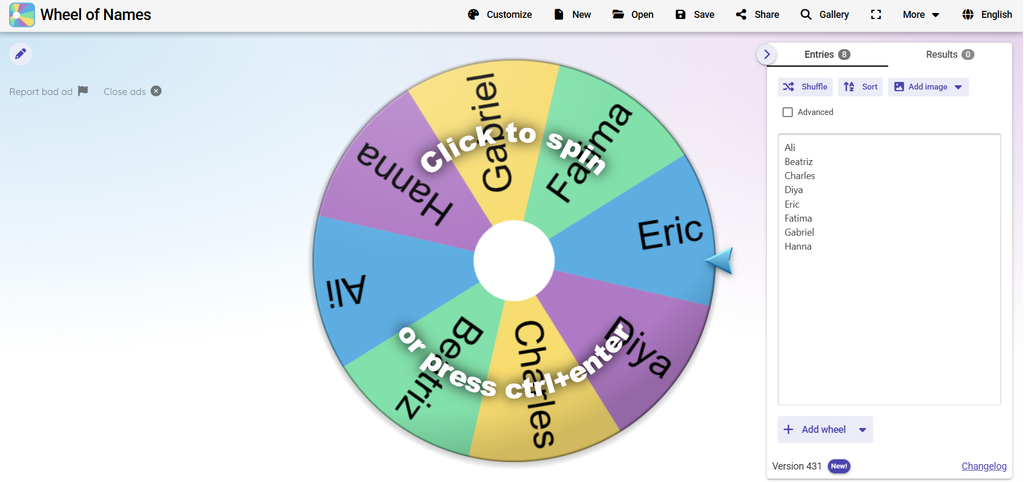
- Add your entries. Type one per line or paste a list. Many tools also take a CSV or text file, and some import straight from a Google Sheet.
- Clean the list. Take out absent people, fix typos, and check for accidental duplicates. Some wheels have a switch that collapses repeated lines into a single slice.
- Decide what happens to a winner. Keep the name on the wheel if repeats are fine; remove it if everyone should get exactly one turn. Settle this before the first spin and tell the group, so nobody argues about it afterward.
- Spin. Click the wheel or its center button. On a shared screen, leave the result up a little longer than feels necessary so the whole room registers it.
- Record the result. Many wheels keep a history while the page stays open. For an online giveaway, screen-record the spin so entrants can watch it happen.
- Save or share the wheel. Save it if you’ll reuse the list, or send a link. A shared link is a snapshot, so later edits won’t show up until you generate a new one.
What people use a wheel of names for?
The same wheel serves teachers, giveaway hosts, meeting leaders, streamers, and friends who can’t pick a restaurant. The settings that suit each are different.
In the classroom
Cold-calling with a wheel takes the “why me?” out of it, because students can see the wheel made the pick, not the teacher. It works like equity sticks, a cup of popsicle sticks with one student’s name on each. One wheel per class is a common setup, opened whenever a question comes up.
Names are only the start. Teachers load wheels with writing prompts, review questions, vocabulary, classroom jobs, and exercises for movement breaks. Picture entries help younger and language learners name what they see. In a music room, a wheel can hand out instruments or dynamics so participation stays balanced.
Giveaways and raffles
For a giveaway, the wheel works as a visible draw: entrants go on, you spin, and you remove each winner if there’s more than one prize. wheelofnames.com can link to a Google Sheet, so survey responses appear on the wheel as they arrive, though removing a winner breaks that live link.
Bigger draws call for a paper trail. Uplup produces a downloadable certificate describing how each draw was made, and WheelNames.org logs a tamper-evident record of the result, timestamp, and entries. If money or a regulated prize is involved, contest law and platform rules still apply. A spinner doesn’t replace them.
Meetings and teams
Standups run smoother when nobody has to volunteer to go first, and randomizing who speaks first is a use the site itself lists. Remove each speaker after their turn to build a full running order, or keep everyone on the wheel when you only need one presenter. To split a whole room into groups, use a team or group generator instead of spinning over and over.
Decisions and games
Low-stakes decisions are where a wheel is most fun: dinner, a movie, whose turn it is. Add only options you’d genuinely accept, and agree to follow the result before anyone spins. The same approach covers party games, from choosing who goes first to picking a dare or a karaoke song.
Streaming
Streamers add the wheel to OBS or Streamlabs as a browser source. Typical uses are viewer giveaways, random challenges such as a weapon restriction, and picking a character build.
Is a wheel of names really random?
With equal slices and a decent random source, yes. Each spin is independent, so no entry has an edge. The trouble is that random results rarely look the way people expect.
Flip a coin ten times, and you get exactly five heads only about 25% of the time. A wheel has no memory of earlier spins either, so the same logic applies.
So can a wheel be rigged? A well-built one has no hidden bias, and weighted odds show up in the slice sizes. There are two real caveats. Browser tools run on the visitor’s device, and no site can stop someone from altering code locally. And the weak point is usually the list: whoever edits the entries controls who’s in the draw. For anything public, show the list before you spin.
How Many Entries a Wheel Can Hold?
Technically thousands. Readably, a few dozen. Tools cap what they draw on screen: 250 slices on Uplup and 1,000 names on wheelofnames.com, but every entry stays eligible. SeatingChartMaker says a wheel gets crowded past about 100 slices, and its share links top out around 2,000 characters.
Is Wheel of Names Safe to Use?
It depends on the tool and on how you save. SeatingChartMaker says its wheel runs locally and never sends the list to its servers. wheelofnames.com keeps a wheel on your device by default and stores it on its servers, in Google’s US data centers, only if you choose cloud saving; a local file never leaves your machine.
Shared links vary too. When a tool encodes the list into the URL, anyone with the link can decode the entries. And if a tool offers an AI helper for suggesting entries, check what it sends. NamesOnWheel’s Ideas feature passes your prompt to an AI service, so it advises typing a topic rather than names.
For classes, stick to first names or initials, and check your school’s policy before uploading a full roster to any third-party site.