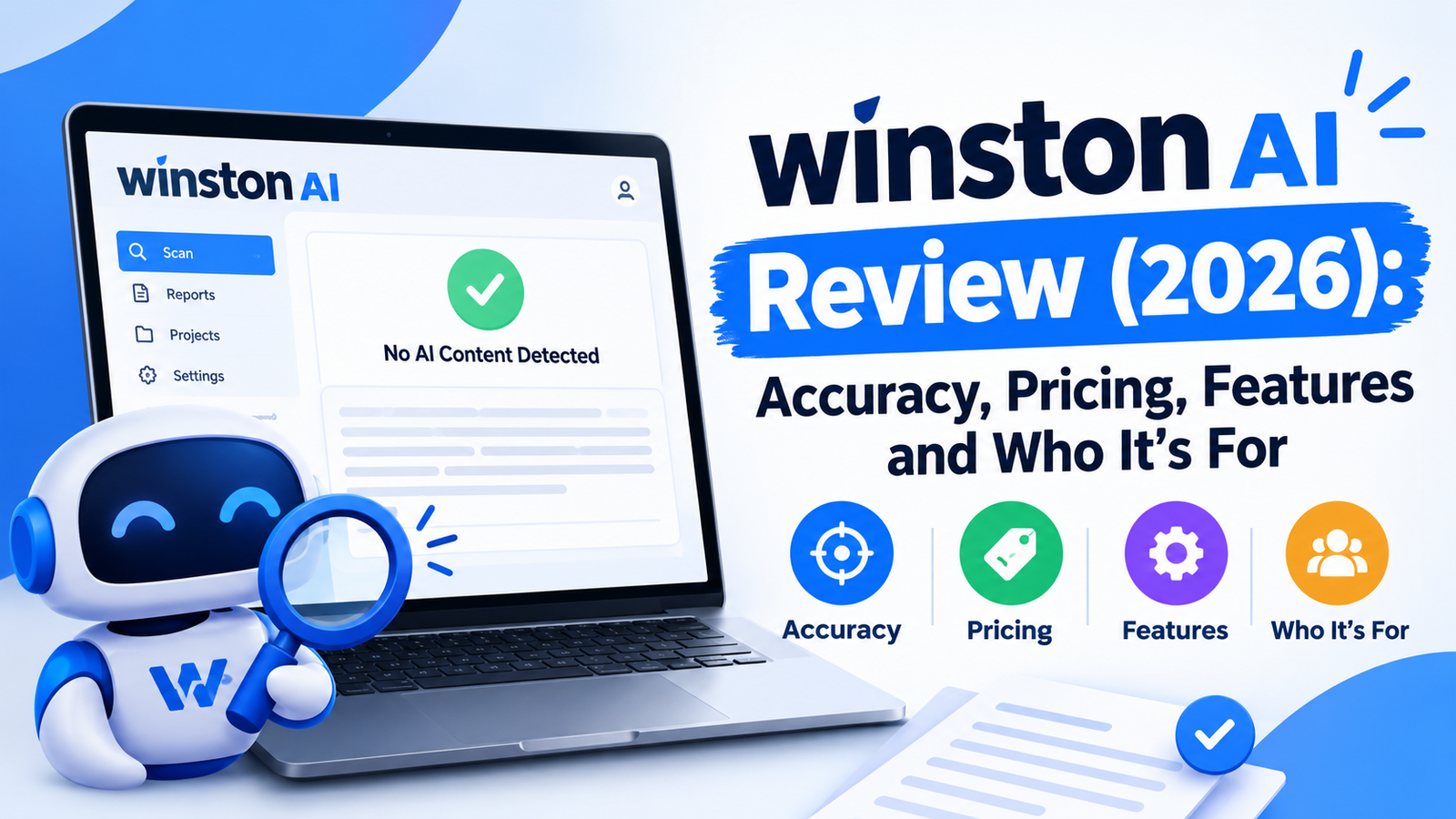
Winston AI is a paid AI content detector and plagiarism checker. You give it text, and it estimates how likely it is that a human wrote it. It also checks images for AI generation and reads scanned pages and handwriting.
Winston AI comes from Winston AI Inc., a Montreal company founded in 2022. Teachers use it to check student work, editors and SEO teams use it before publishing, and developers connect to it through an API. You paste text or upload a .docx, .png or .jpg file. Winston returns a score from 0 to 100 and a sentence-by-sentence breakdown.
The toolset is broad, but the headline accuracy claim needs more scrutiny than most reviews give it.
Key features
- AI text detection with an AI prediction map that color-codes predictable passages.
- Plagiarism checking that highlights matches and links to the sources.
- AI image and deepfake detection, plus OCR for scans and handwriting.
- Shareable PDF reports and team seats: up to five on Advanced, unlimited on Elite.
- Detection in up to 14 languages, including English, Spanish, French, German and simplified Chinese. Its own FAQ still lists 11.
- Listed integrations: a Chrome extension, WordPress plugin, Google Classroom, Zapier and an API.
- A HUMN-1 certification badge for websites, on the higher plans.
How it works, and how to read the score
Winston pairs linguistic analysis, including perplexity and burstiness, with a model trained on both human and AI-written text. The output is a probability, not a verdict. A score of 80% human means Winston is 80% confident a person wrote the text. It does not mean 20% of the text came from AI. The prediction map is separate: it highlights predictable sentences, and it can shade genuinely human writing too. Winston says it updates its detection weekly.
How accurate is Winston AI?
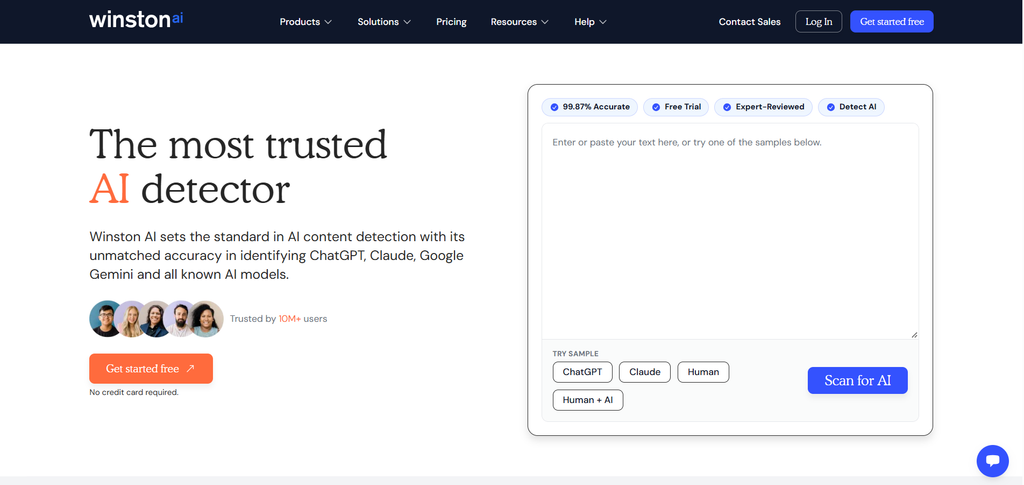
Winston advertises 99.98% accuracy. Its research page splits that figure: 99.98% was the AI-detection rate for its Luka model, with 99.74% overall across 10,000 samples, and the newer Curia model reports 99.95% overall on an English dataset. Both sets of numbers come from Winston’s own testing.
Outside evidence is mixed. A peer-reviewed study from the University of Osijek, which Winston highlights, put it at 99%, just ahead of Originality.ai at 98%. Older tests summarized by review sites landed at roughly 76% to 83%.
False positives matter most in classrooms. DetectArena lists Winston’s false-positive rate at 0.5%, while one small test flagged 4 of 40 human samples. Detectors in general also struggle with non-native English: a 2023 Stanford study found seven of them misclassified 61% of TOEFL essays as AI on average. Treat a score as a reason to look closer, never as proof. If a flag worries you, ask for drafts and version history before drawing any conclusion.
Winston AI pricing
Prices as of 2026. Annual billing lowers the monthly rate, and older reviews quote higher figures.
| Plan | Monthly | Annual (per month) | Credits per month | Notes |
|---|---|---|---|---|
| Free | $0 | $0 | 2,000 (14-day trial) | Trial only |
| Essential | $18 | $10 | 100,000 | AI text and image detection |
| Advanced | $29 | $16 | 200,000 | Adds plagiarism check, up to 5 seats |
| Elite | $49 | $26 | 500,000 | Unlimited seats |
Credits map to words. AI detection costs 1 credit per word, plagiarism checking 2, and an image scan 300. A 1,500-word article therefore costs 1,500 credits for AI detection, or 4,500 with plagiarism switched on. The trial’s 2,000 credits won’t cover the second case.
Essential’s 100,000 credits stretch to about 66 such articles for AI detection alone, and Advanced’s 200,000 to about 44 with both checks. Paid plans accept up to 200,000 characters per scan. Monthly plans cancel at the end of the paid term, but annual plans can’t be cancelled mid-term.
Pros and cons
Pros: One subscription covers text, image and plagiarism checks. Sentence-level highlighting and shareable reports make results easy to explain. OCR handles scans and handwriting. Weekly model updates, an API and integrations suit publishing workflows.
Cons: The free plan is a 14-day trial. Headline accuracy rests mostly on company data. Edited or paraphrased AI text can slip through, and human writing can be flagged. Credit costs differ by feature, and annual plans lock you in.
Who should use Winston AI?
It suits editors, SEO teams and agencies that want AI detection, plagiarism checks and reports in one place, and educators who need to check scanned or handwritten work. It’s a weaker choice if you need a permanent free tier or plan to penalize anyone on a score alone.
How to use Winston AI
- Create an account. The free trial needs no card.
- Start a content scan and paste text or upload a file.
- Pick your checks. AI detection is on by default; plagiarism and writing feedback cost extra credits.
- Run the scan and read the human score, the prediction map and the sections driving the AI score.
- Download or share the PDF report.
Winston AI alternatives
| Tool | Choose it if |
|---|---|
| GPTZero | you want a free tier and LMS integrations |
| Originality.ai | you publish at volume and prefer pay-as-you-go credits |
| Pangram | false positives matter most (DetectArena lists 0.01%) |
| Copyleaks | you need 30+ languages |
| Turnitin | your school already uses it for plagiarism checks |
Verdict
Winston AI is a well-rounded detector for teams that want AI detection, plagiarism checks and reports in one subscription. Its accuracy looks strong on the company’s own tests and mixed elsewhere, so use it as one signal alongside editing judgment, drafts and context.