
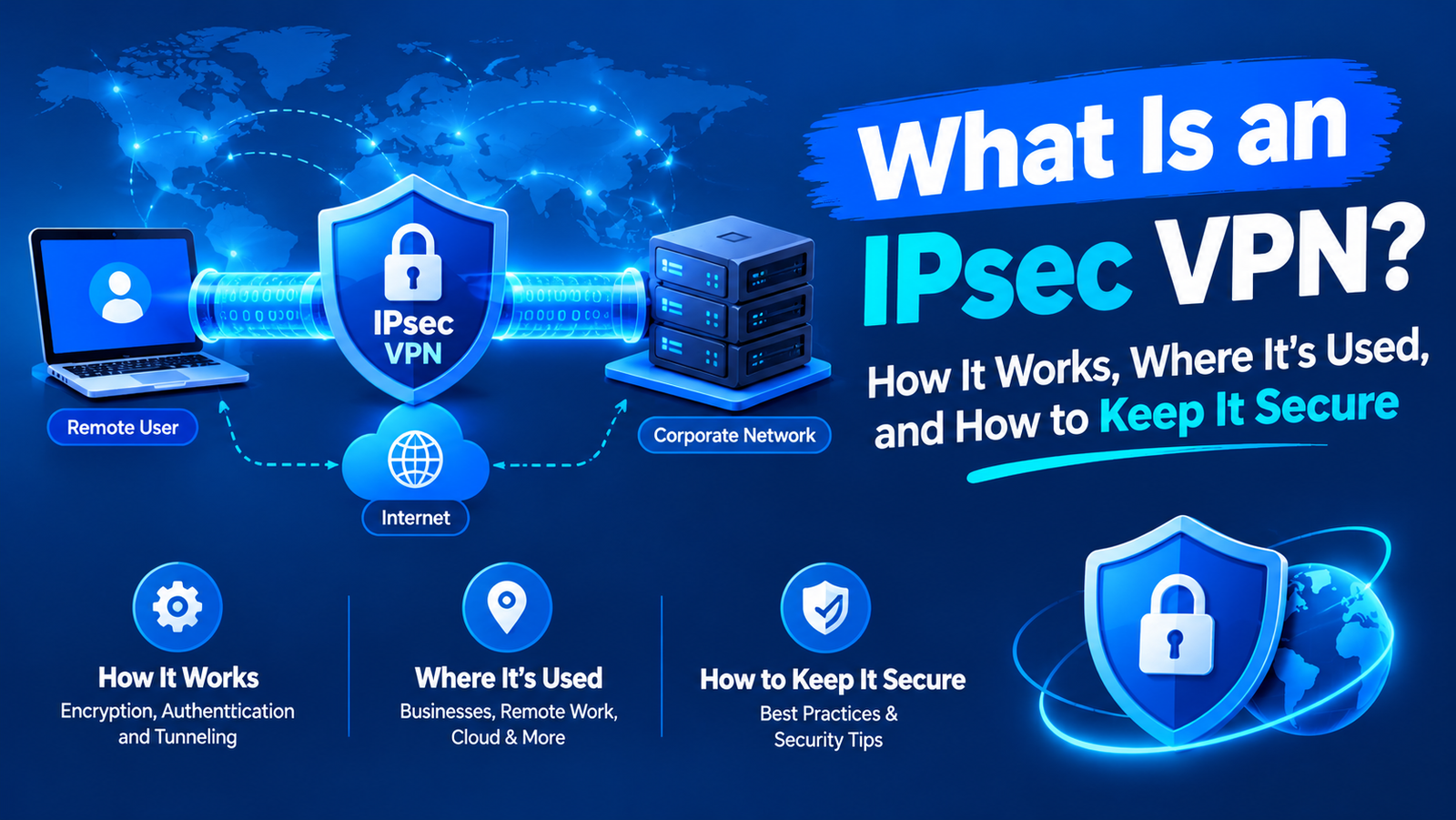
If your company’s branch office talks to headquarters, or your cloud servers connect back to an on-premises data center, there’s a good chance an IPsec VPN is doing the work. It’s also running quietly on millions of phones every time someone chooses “IKEv2” in a VPN app.
This guide explains what an IPsec VPN is in plain terms, walks through how the connection is built, compares it with SSL VPNs and WireGuard, and covers what US security agencies currently recommend for keeping it safe.
What Is an IPsec VPN?
An IPsec VPN is a virtual private network that uses the Internet Protocol Security (IPsec) suite to encrypt and authenticate data as it travels between two points over a public network like the internet. It creates a protected “tunnel” so that anyone intercepting the traffic sees only scrambled data.
IPsec is not a single protocol. It’s a framework of open standards maintained by the Internet Engineering Task Force (IETF), and it works at the network layer (Layer 3). That’s its defining trait: because it protects IP packets themselves, it secures every application on the connection, from email and file transfers to VoIP calls, without each app needing its own encryption.
Think of it like shipping documents in a locked, tamper-evident container instead of a paper envelope. The courier can move the container, but can’t read or alter what’s inside without it being obvious.
The Core Components of IPsec
| Component | What it does | Network details |
|---|---|---|
| IKE (Internet Key Exchange) | Authenticates both sides and negotiates encryption keys. IKEv2 is the current standard. | UDP port 500 (4500 through NAT) |
| ESP (Encapsulating Security Payload) | Encrypts the data and checks it hasn’t been altered | IP protocol 50 |
| AH (Authentication Header) | Verifies integrity but doesn’t encrypt; rarely used today | IP protocol 51 |
| Security Association (SA) | The agreed “contract” of algorithms and keys for a connection | Stored on each device |
How an IPsec VPN Works, Step by Step
- Traffic triggers the tunnel. A device or gateway sees traffic headed for a protected network and starts the IPsec process.
- The two sides authenticate. Using IKE, each peer proves its identity with a digital certificate or a pre-shared key, then runs a Diffie-Hellman exchange to create shared secret keys without ever sending them across the network.
- They agree on the rules. The peers negotiate Security Associations covering the encryption algorithm (typically AES), the integrity check, and how long keys stay valid.
- Data flows securely. ESP encrypts each packet, adds an integrity check and a sequence number to block replay attacks, and sends it on its way. The receiving side verifies and decrypts it.
- Keys refresh, then the tunnel closes. Keys are replaced on a schedule during long sessions, and the tunnel shuts down when it’s no longer needed.
One practical detail: most home and office networks use NAT, which can break IPsec packets. NAT traversal solves this by wrapping IPsec traffic inside UDP port 4500, which is why that port needs to be open on firewalls.
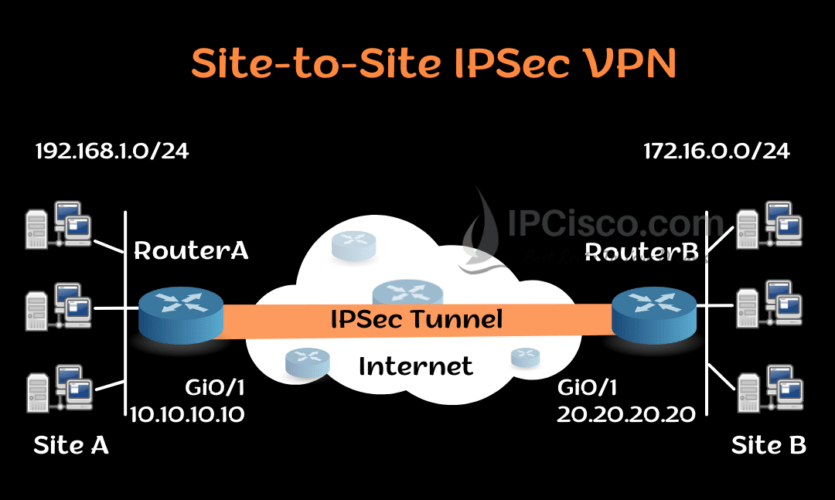
Source: https://ipcisco.com/lesson/cisco-ipsec-vpn-configuration/
Tunnel Mode vs. Transport Mode
Tunnel mode encrypts the entire original packet, including its header, and wraps it inside a new one. Outsiders can’t even see the true source and destination inside your network. This is the default for VPNs between sites and for remote access.
Transport mode encrypts only the data portion and leaves the original header visible. It’s lighter and is typically used for direct host-to-host protection, such as between two servers.
Types of IPsec VPNs
- Site-to-site: Connects entire networks, like a branch office to headquarters or an on-premises data center to a cloud network on AWS, Azure, or Google Cloud. Users don’t install anything; the gateways handle it.
- Remote access: Connects an individual device to a private network. Windows, macOS, iOS, and Android all include native IKEv2 support, and enterprise clients from firewall vendors build on it.
- Consumer VPN apps: Many commercial VPN services offer IKEv2/IPsec as a protocol option. It’s popular on phones because it reconnects quickly when you switch between WiFi and cellular.
IPsec vs. SSL/TLS VPN vs. WireGuard
| IPsec | SSL/TLS VPN | WireGuard | |
|---|---|---|---|
| Layer | Network (Layer 3) | Transport/application | Network (Layer 3) |
| Best for | Site-to-site links, full network access | Browser-based or app-level remote access | Fast, simple modern tunnels |
| Setup | Complex, many options | Easier for end users | Very simple |
| Firewall friendliness | Needs UDP 500/4500 open | Uses port 443, rarely blocked | Single UDP port |
| Maturity | Decades of enterprise use | Widely deployed | Newer, rapidly adopted |
In short, IPsec remains the enterprise standard for connecting networks and works with nearly every router, firewall, and cloud platform. SSL VPNs are often easier for remote users behind restrictive networks, and WireGuard wins on simplicity and speed but offers fewer enterprise controls.
Advantages and Disadvantages
Advantages: It protects all IP traffic at once, it’s an open standard supported by virtually every vendor, it uses strong encryption with built-in replay protection, and it’s invisible to users once configured.
Disadvantages: Configuration is complex and mismatched settings are a common cause of failed tunnels. It can be blocked by strict firewalls, adds some processing overhead, and a remote access tunnel gives broad network access unless it’s carefully restricted.
Is IPsec Still Secure in 2026?
The protocol itself holds up well when it’s configured correctly. NIST’s guide to IPsec VPNs (SP 800-77 Revision 1) recommends IKEv2 with modern algorithms such as AES and SHA-2, and steers administrators away from legacy options like DES and 3DES.
Most real-world VPN breaches don’t come from cracking IPsec encryption. They come from unpatched VPN appliances and stolen passwords. CISA has repeatedly ordered federal agencies to urgently patch actively exploited remote access VPN products, including Cisco firewalls in September 2025 and Check Point VPN products in June 2026. Those were product bugs, not protocol flaws, but the lesson is the same: the gateway is often the weakest link.
The next challenge is quantum computing. Attackers can record encrypted traffic today and decrypt it later once quantum computers are powerful enough, an attack known as “harvest now, decrypt later.” The NSA’s CNSA 2.0 guidance calls for VPN equipment in national security systems to support and prefer quantum-resistant algorithms starting in 2026 and to use them exclusively by 2030. The IETF is finalizing a standard for adding the NIST-approved ML-KEM algorithm to IKEv2, building on an existing standard (RFC 9370) that lets IPsec combine classic and post-quantum key exchanges.
IPsec VPN Best Practices
- Use IKEv2 only and retire IKEv1, especially aggressive mode with pre-shared keys.
- Prefer certificates over pre-shared keys for authentication, and store keys securely.
- Choose strong algorithms, such as AES-GCM with elliptic-curve Diffie-Hellman groups 19 or 20.
- Require multi-factor authentication for every remote access user.
- Patch VPN gateways fast and follow CISA’s Known Exploited Vulnerabilities catalog.
- Limit access so remote users reach only the systems they need.
- Ask vendors about post-quantum support before your next hardware refresh.