
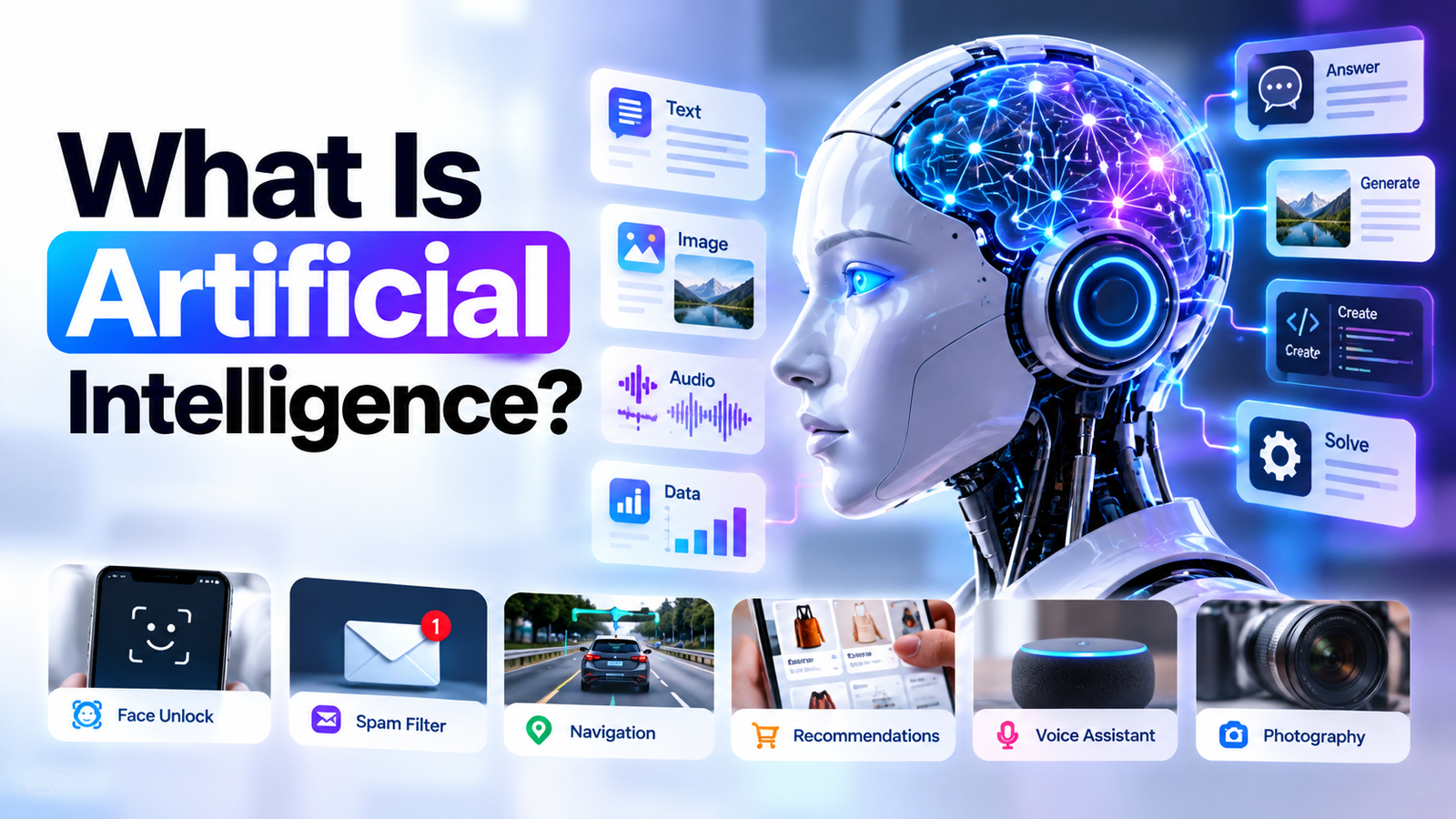
Artificial intelligence is software that learns patterns from data and uses them to produce outputs, rather than following rules a programmer wrote by hand. That’s the whole distinction. A spam filter that was explicitly told “block anything containing this phrase” is ordinary software; one that worked out for itself what spam tends to look like is AI.
Every definition you’ll read adds something about human intelligence, reasoning or decision-making. Those aren’t wrong, but they describe the ambition rather than the mechanism, and they’re a large part of why the term feels slippery. This article sticks to the mechanism, then works outward to what it means for the tools you already use.
Why the definition keeps moving
Here’s the oddity at the heart of the subject: things stop being called AI once they work reliably.
Optical character recognition was an AI problem in the 1970s. Chess was the benchmark for machine intelligence until a computer won in 1997, at which point chess became “just search”. Spam filtering, GPS route-finding, autocorrect and face detection in your camera app were all AI research topics. Now they’re features, and nobody calls them intelligent.
The computer scientist Larry Tesler is usually credited with the observation that intelligence is whatever machines haven’t done yet. It’s a joke with a real consequence: “AI” is less a category of technology than a moving label for the frontier. When you read that a product “uses AI”, the useful question is which specific technique, not whether it qualifies for the badge.
What every AI system has in common
Strip away the marketing and four components show up every time.
Input. Text, an image, a sound, a table of numbers, a sensor reading. Something measurable.
A learned model. This is the part that makes it AI. During training, the system is exposed to large amounts of data and adjusts millions or billions of internal numbers — weights — until its outputs match what it’s shown. Nobody writes those numbers. Nobody can read them and explain what each one does.
Output. A label, a prediction, a sentence, an image, an action.
An error rate. This is the component most explanations skip, and it’s the one that matters most in daily use. AI systems are probabilistic. They produce the most likely answer given what they learned, not the correct answer retrieved from a store of facts. They are wrong a measurable percentage of the time, by design, and no amount of improvement removes that property.
Understanding the fourth point explains nearly every frustration people have with these tools. A chatbot inventing a citation isn’t malfunctioning. It’s doing exactly what it does — producing plausible text — in a case where plausible and true came apart.
The nesting: AI, machine learning, deep learning, generative AI
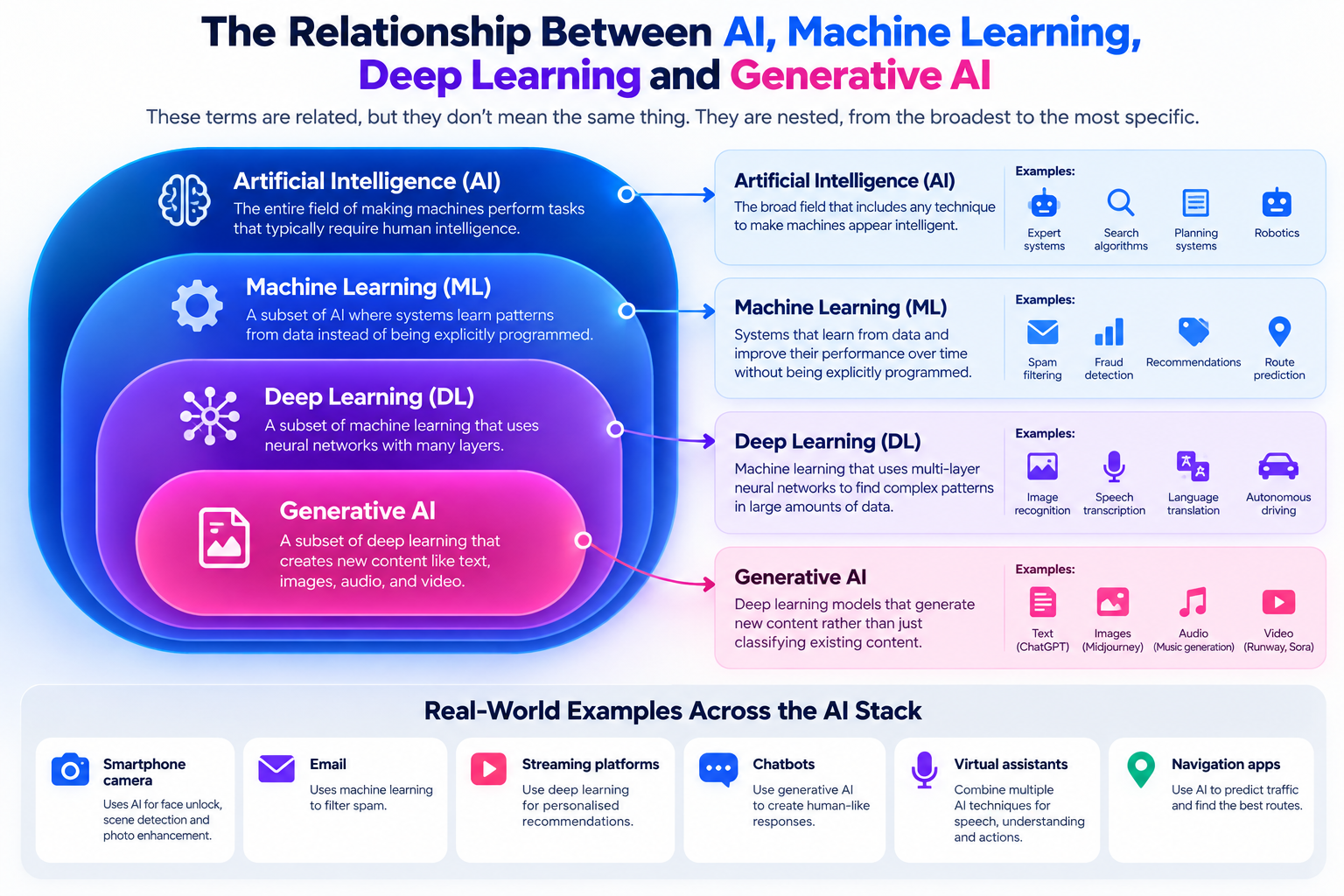
These four terms get used interchangeably in press coverage. They’re nested, from widest to narrowest.
- Artificial intelligence is the whole field, dating to the 1950s. It includes approaches that involve no learning at all, such as the hand-coded expert systems that dominated the 1980s.
- Machine learning is the subset where the system derives its own rules from data. Most practical AI since the 1990s.
- Deep learning is machine learning using neural networks with many layers. It’s what made image recognition and speech transcription work properly, from roughly 2012 onward.
- Generative AI is the newest slice: deep learning models that produce new content — text, images, audio, video — rather than classifying existing content. ChatGPT, Midjourney and their competitors all sit here.
When someone says “AI” in 2026 conversation, they almost always mean generative AI, which is one corner of one corner of the field.
Narrow, general, and the one that doesn’t exist
Two categories are worth keeping straight.
Narrow AI does one class of task. Every AI system that exists, without exception, is narrow. A model that writes excellent code cannot drive a car, and one that recognises tumours cannot hold a conversation. Breadth within a domain has grown enormously; the systems are still narrow.
Artificial general intelligence would match human ability across arbitrary tasks, including ones it was never trained on. It does not exist. Whether it’s five years away or a permanent research goal is genuinely disputed among people who know the field well, and anyone stating a confident date is expressing an opinion rather than reporting a fact.
You’ll also see “superintelligence” — hypothetical systems beyond human capability. That’s a philosophy and policy discussion, not a description of anything running today.
Where AI already is in your life
Most people’s first real AI experience was a chatbot. It was nowhere near their first AI experience.
If you use a smartphone, AI ranks your photo library and lets you search it for “dog” without anyone having tagged the photos. It powers face unlock, autocorrect predictions, and the voice assistant. Your bank runs fraud detection models on every transaction. Your email provider filters spam with one. Streaming and shopping recommendations are built on them. Navigation apps predict traffic with them. Modern cameras use them to decide exposure.
If you’re comparing the different AI assistants available today, see our guide to the best AI assistants in 2026.
None of this was announced as AI, because it arrived quietly and worked. That’s the AI effect in action, and it’s a useful corrective to both the hype and the alarm: the technology has been embedded in ordinary life for well over a decade.
What AI is not
- Not a database. It doesn’t look facts up. It generates a likely answer, which is why it can be confidently wrong about something easily verified.
- Not a search engine, though some products now bolt search onto a model to compensate for exactly that weakness.
- Not conscious, not self-aware, not thinking. A language model has no understanding of what it writes, no goals of its own, and no continuous existence between conversations.
- Not one technology. The model that transcribes your voice and the one that generates an image share a mathematical family and almost nothing else.
- Not inherently neutral. Systems learn from data produced by people, and they reproduce the patterns in that data, including the unwanted ones.
Why 2022 felt like a sudden jump
The underlying research didn’t appear overnight. Neural networks were proposed in the 1940s. The term was coined in 1956 at a Dartmouth College workshop. The transformer architecture behind today’s language models was published in 2017.
Three things converged. Model size grew by orders of magnitude and produced capabilities nobody had specifically engineered. The computing power to train at that scale became available. And in November 2022, one of those models was wrapped in a chat box that anyone could type into.
That third factor is the one most coverage underrates. The capability jump was real, but what changed for the public was the interface. The technology had been sitting behind an API that only developers could reach.
Is it AI, or is it marketing?
A test you can apply to any product claim. Ask what the system learned from, and what happens when it’s wrong.
If the vendor can describe the training data and quotes an accuracy figure, there’s probably a real model underneath. If the answer is “advanced algorithms” and there’s no discussion of error rates, you’re likely looking at conventional software with a new label — which has been common since roughly 2023, when the word started selling things.