
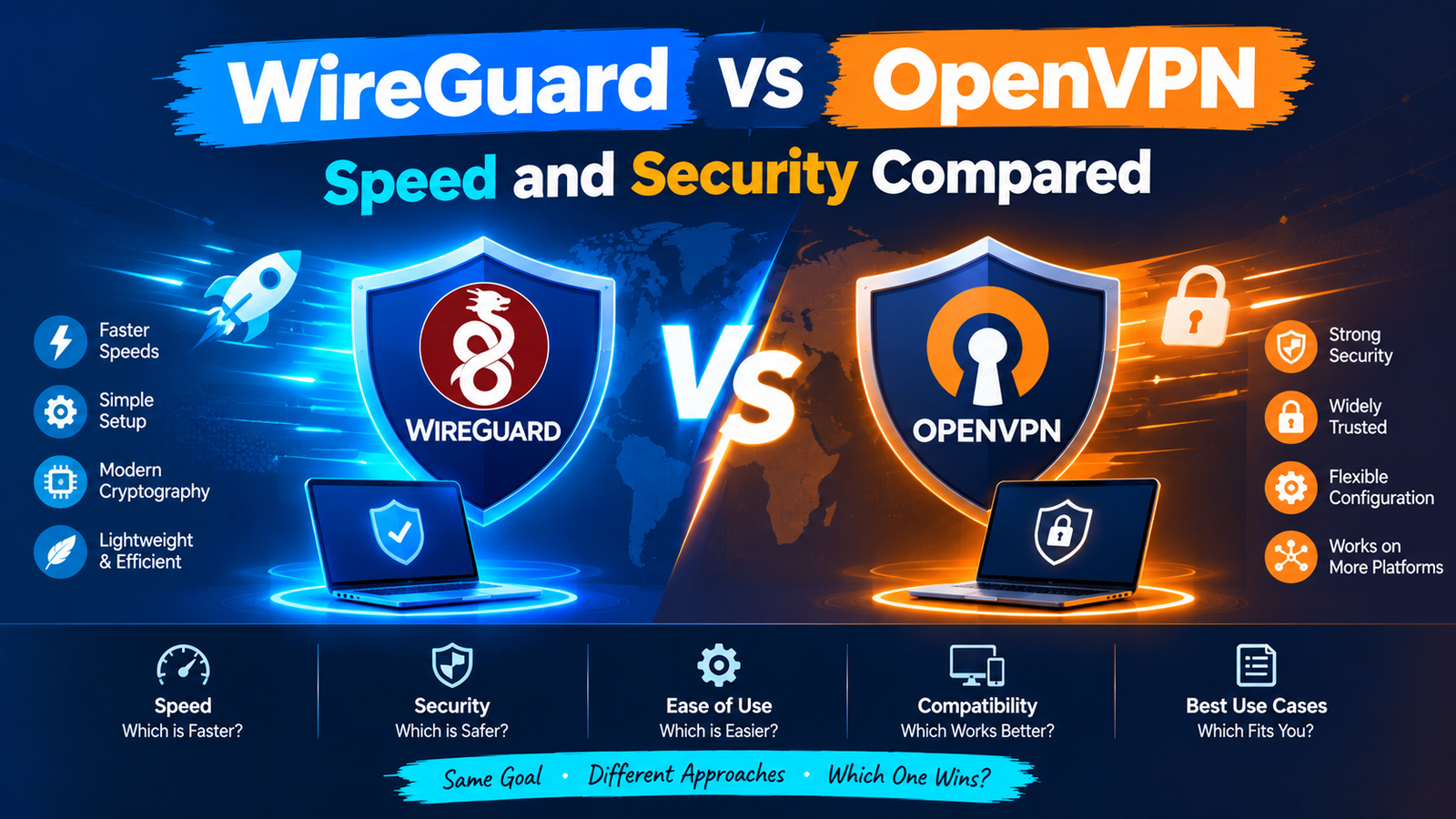
WireGuard is the faster protocol and OpenVPN is the more flexible one, and on security there is no meaningful winner both are sound, they simply fail in different directions. Pick WireGuard for everyday use on any modern device. Keep OpenVPN for networks that block you, routers too old to run anything else, and setups that need cryptographic options WireGuard deliberately doesn’t offer.
That’s the summary every comparison arrives at. The part worth reading is why, because the usual explanations for the speed gap are wrong, and the speed gap itself is smaller than it looks for most people on most connections.
At a glance
| WireGuard | OpenVPN | |
| Released | 2015, stable 2020 | 2001 |
| Codebase | ~4,000 lines | ~70,000 lines core |
| Where it runs | Kernel space | User space (kernel with DCO) |
| Transport | UDP only | UDP or TCP |
| Cipher | ChaCha20-Poly1305, fixed | AES-GCM or ChaCha20, negotiable |
| Handshake | 1 round trip | TLS handshake, several |
| Roaming | Seamless | Usually drops and rebuilds |
| Firewall evasion | None natively | TCP 443 looks like HTTPS |
| Audit history | Short but thorough | Two decades of scrutiny |
Where the speed difference actually comes from
Most articles explain this by saying ChaCha20 is faster than AES. That’s wrong on any device with AES hardware acceleration, which covers virtually every laptop, desktop and recent phone. On that hardware AES-256-GCM is typically the quicker cipher. The cipher is not why WireGuard wins.
Three architectural choices are.
It runs in kernel space. WireGuard was merged into the Linux kernel in 2020. OpenVPN traditionally runs as a user-space process, which means every single packet crosses the boundary between kernel and user space and back. That context switch costs more than the encryption does.
It has no negotiation. WireGuard supports exactly one cipher suite. There is nothing to agree on, no certificate chain to validate, no TLS session to establish. Its handshake completes in a single round trip. OpenVPN runs a full TLS negotiation before the tunnel carries anything.
It carries less state. WireGuard is connectionless. It doesn’t track sessions the way OpenVPN does, so there’s less bookkeeping per packet.
Worth flagging: OpenVPN 2.6 introduced Data Channel Offload, which moves bulk encryption into the kernel and closes much of this gap. Few consumer providers have shipped it yet, so the familiar ranking still holds in practice, but the architectural argument is weaker than it was two years ago.

Will you actually notice?
Published figures put WireGuard anywhere from 1.5 to 4 times faster than OpenVPN. Those numbers are real, and for most people they’re also irrelevant.
Here’s why. A protocol comparison only shows a difference when the protocol is the bottleneck. If your home connection delivers 200 Mbps and a modern laptop can push 400 Mbps through OpenVPN, both protocols saturate your line and you measure the same speed either way. The gap only becomes visible in three situations:
- Gigabit or faster connections, where the protocol becomes the limiting factor.
- Weak hardware routers, older phones, single-board computers where CPU runs out before bandwidth does.
- Battery-sensitive use, where the difference shows up as runtime rather than throughput.
If you’re on a typical US broadband line with a device made in the last five years, switching protocols will change your speed test by less than the variation between two consecutive runs. What will change it is covered further down.
Roaming: the difference you feel rather than measure
Throughput isn’t the only axis, and on a phone it isn’t the most noticeable one. Move from Wi-Fi to cellular and OpenVPN generally treats the new address as a new connection the tunnel drops, renegotiates, and for a few seconds nothing loads. WireGuard is connectionless, so it simply starts sending from the new address, and the single round-trip handshake makes the transition close to invisible. Day to day, that matters more than a speed test.
Security: not a tie, but not a ranking either
Calling this a tie, as most comparisons do, skips the interesting part. Neither protocol has a known practical vulnerability. They arrive at that position by opposite routes.
Attack surface. WireGuard’s roughly 4,000 lines can be read end to end by one reviewer in a day. OpenVPN’s core is around 70,000 lines and it leans on OpenSSL or mbedTLS, inheriting whatever those libraries carry TLS is a large, complicated thing with a history that includes Heartbleed. Smaller surface is a genuine structural advantage.
Cryptographic agility. WireGuard has none, on purpose. One cipher suite, no negotiation, therefore no downgrade attacks a whole class of failure simply doesn’t exist. The cost is that changing algorithms requires a new protocol version. OpenVPN can swap ciphers on the fly, which is what enterprises with compliance requirements need and what makes it survivable if a cipher ever weakens.
Track record. OpenVPN has been attacked by researchers for over twenty years and is still standing. WireGuard has been formally verified and audited, but it has been in production for a fraction as long. If your threat model favours conservatism, that argument still carries weight.
Post-quantum. WireGuard supports an optional pre-shared key layered onto its handshake, which provides resistance against an adversary recording traffic now to decrypt later. It’s off by default and most consumer apps don’t expose it, but it exists.
One caveat belongs to WireGuard alone. In its plain form it assigns each peer a static internal IP and keeps that association, which is worse for privacy than OpenVPN’s dynamic assignment. Reputable providers layer dynamic addressing on top that’s what branded names like NordLynx describe. It’s a deployment question rather than a protocol flaw, but it’s worth asking your provider about.
The thing that decides it for most people
WireGuard is UDP-only and has no TCP fallback. On a network that drops or deprioritises UDP plenty of hotels, campuses, corporate guest networks and some mobile carriers WireGuard doesn’t run slowly, it doesn’t connect at all. OpenVPN over TCP 443 looks like ordinary HTTPS traffic and gets through almost anything, because blocking it would break the web.
This is the practical reason to keep both configured. Use WireGuard as your default and switch to OpenVPN-TCP when a connection refuses to come up. Neither protocol has native obfuscation against serious censorship; that’s a separate layer providers add on top.
What actually limits your VPN speed
Before blaming the protocol, check these in order. In my experience this resolves most “my VPN is slow” complaints without touching the protocol setting.
- Distance to the exit server. Latency is bounded by physics. A server on another continent caps everything inside the tunnel regardless of protocol.
- Server load. A congested server at 95% capacity will beat any protocol choice for impact.
- Your own line speed. Test without the VPN first to establish the ceiling.
- MTU. Oversized packets being silently dropped produce stalls that look like slowness.
- Device CPU. Older routers in particular run out of processing headroom long before bandwidth.
Which should you use?
- Most people, most devices: WireGuard. Faster where it matters, lighter on battery, simpler to reason about.
- Restrictive network, or WireGuard won’t connect: OpenVPN over TCP 443.
- Old router or unsupported device: OpenVPN, which runs on nearly anything.
- Regulated or enterprise environment: OpenVPN, where configurable ciphers are often a requirement rather than a preference.
- Maximum caution about protocol maturity: OpenVPN, on track record alone. It’s a defensible position, not a necessary one.
If you’re new to VPNs, start with our guide on what a is VPN and how it works before comparing the protocols.
1 thought on “WireGuard vs OpenVPN: Speed and Security Compared”
Comments are closed.