
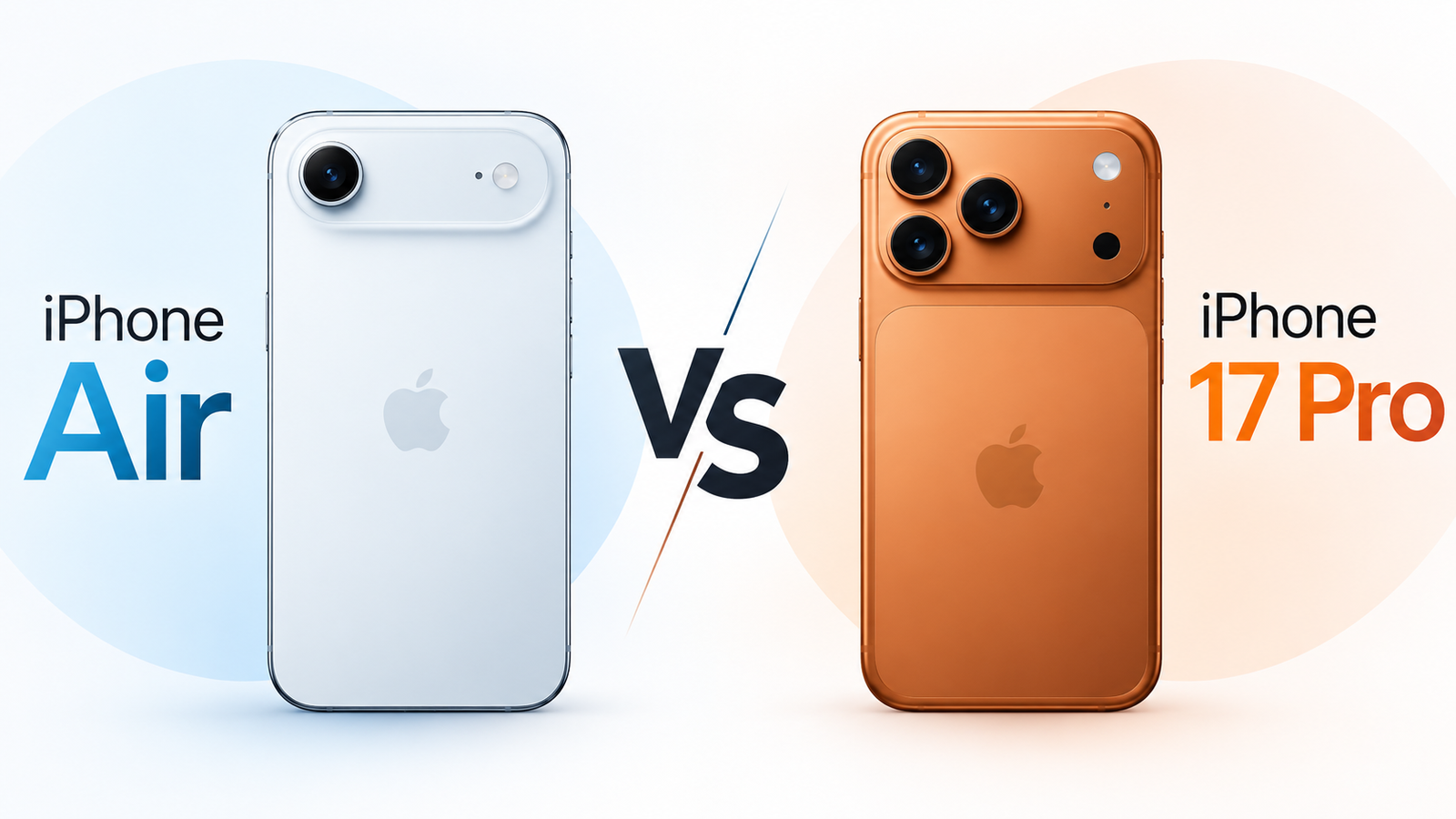
Between the iPhone Air vs 17 Pro, choose the iPhone Air if you want the thinnest, lightest iPhone with a larger screen, and choose the iPhone 17 Pro if cameras, battery life and long gaming or video sessions matter more. They share the same A19 Pro chip family and the same amount of memory, so this is a decision about design against capability, not speed.
The fastest way to decide is to pick what you care about most.
iPhone Air vs 17 Pro: Pick the Right One by What You Care About Most
- Comfort in the hand and pocket: iPhone Air. It is 5.6mm thin and weighs 165g.
- Zoom and ultra wide photos: iPhone 17 Pro. The Air has one rear camera.
- Longest battery life: iPhone 17 Pro.
- Bigger screen: iPhone Air, at 6.5 inches against 6.3.
- You need a physical SIM card: neither one in the US, where both are eSIM only. In many other countries the 17 Pro still has a SIM tray, and the Air never does.
- Buying new from Apple today: iPhone Air. Apple discontinued the 17 Pro in September 2026.
Full Spec Comparison: iPhone Air vs iPhone 17 Pro
| Feature | iPhone Air | iPhone 17 Pro |
|---|---|---|
| Display | 6.5-inch OLED, 120Hz | 6.3-inch OLED, 120Hz |
| Thickness | 5.6mm | 8.75mm |
| Weight | 165g | 206g |
| Frame | Titanium | Aluminum unibody |
| Chip and memory | A19 Pro, 12GB | A19 Pro, 12GB |
| Cooling | Standard | Vapor chamber |
| Rear cameras | 48MP main only | 48MP main, ultra wide and 4x telephoto |
| Front camera | 18MP Center Stage | 18MP Center Stage |
| Video playback (Apple’s figure) | Up to 27 hours | Up to 33 hours |
| Speakers | Single speaker | Stereo |
| SIM | eSIM only | eSIM only in the US and some other countries, SIM tray elsewhere |
| USB-C speed | USB 2 | USB 3, up to 10Gbps |
| Storage | 256GB, 512GB, 1TB | 256GB, 512GB, 1TB |
| Launch price (US) | $999 | $1,099 |
| Apple Store status, October 2026 | On sale from $1,099 | Discontinued |
Design and Comfort: How Much Thinner and Lighter the iPhone Air Really Is
The Air is about a third thinner than the 17 Pro and 41g lighter, and that is noticeable the moment you pick it up. It also has the larger display of the two. If you read a lot on your phone, hold it one-handed on a commute or simply dislike heavy phones, this is the Air’s entire argument, and it is a strong one.
The 17 Pro is thicker and heavier because it carries a bigger battery, three cameras and a vapor chamber. You feel that weight, and you also get something for it.
Cameras: What You Give Up With the iPhone Air’s Single Lens
The Air’s 48MP main camera takes excellent everyday photos and offers a 2x optical-quality crop. What it cannot do is go wide or zoom far.
- No ultra wide. Group shots in tight rooms, sweeping landscapes and close-up macro photos are all jobs for the ultra wide lens the Air does not have.
- No telephoto. The 17 Pro reaches 4x optically and 8x at optical quality. The Air relies on digital zoom beyond 2x.
- Fewer pro video tools. ProRes RAW and the other filmmaker features are on the Pro.
Both phones share the same 18MP Center Stage front camera, so selfies and video calls are a tie.
Battery Life and Performance: Where the iPhone 17 Pro Pulls Ahead
Apple rates the Air at up to 27 hours of video playback and the 17 Pro at up to 33. In practice the Air gets most people through a day, but heavy users are more likely to reach for a charger by evening. Apple sells a slim MagSafe battery made for the Air for exactly that reason.
Speed is close in short bursts because both use an A19 Pro chip with 12GB of memory. The Pro’s vapor chamber lets it stay fast for longer during demanding games or long 4K recordings, where a thin phone has less room to shed heat.
eSIM, Speakers and USB Speed: Smaller iPhone Air Trade-Offs Worth Knowing
- eSIM only. The Air has no SIM tray in any country. Check that your carrier supports eSIM, especially if you travel and like to buy local SIM cards. US models of the 17 Pro are eSIM only as well, so this difference mainly matters outside the US.
- One speaker. The Air plays audio from a single speaker, so videos and music sound thinner than on the Pro’s stereo pair.
- Slower USB-C. Fine for charging and occasional transfers. Slow if you regularly move large video files.
Price and Availability of the iPhone Air and 17 Pro in Late 2026
When both launched in September 2025, the Air cost $999 and the 17 Pro $1,099. On September 9, 2026, Apple raised the Air’s starting price to $1,099 and discontinued the 17 Pro to make way for the iPhone 18 Pro, which starts at $1,199.
That leaves three realistic options: a new iPhone Air from Apple, a remaining or refurbished 17 Pro from a carrier or retailer, or the newer iPhone 18 Pro for $100 more than the Air. If you are leaning towards a Pro and the price you find for a 17 Pro is close to $1,199, the newer model is the safer buy. You can check current models on Apple’s comparison page.
The Verdict: iPhone Air or iPhone 17 Pro?
Get the iPhone Air if design is the reason you are upgrading and you take mostly everyday photos. Get the iPhone 17 Pro, at a fair discount, if you want the most capable camera system and the longest battery life of the two. If neither sounds right and you mainly want a good all-rounder for less, our iPhone 17 vs 17 Pro comparison covers the standard model.
Common Questions About the iPhone Air and iPhone 17 Pro
Does the iPhone Air have a SIM card slot?
No. The iPhone Air is eSIM only in every country.
Is the iPhone Air faster than the iPhone 17 Pro?
No. Both use an A19 Pro chip with 12GB of memory. The Pro keeps its performance up for longer under heavy load because of its cooling.
Can the iPhone Air take ultra wide or macro photos?
No. It has a single 48MP main camera, so there is no ultra wide lens and no macro mode.
Which has the bigger screen, the iPhone Air or the 17 Pro?
The iPhone Air, at 6.5 inches. The iPhone 17 Pro is 6.3 inches.
1 thought on “iPhone Air vs 17 Pro: Which One Should You Buy?”
Comments are closed.