
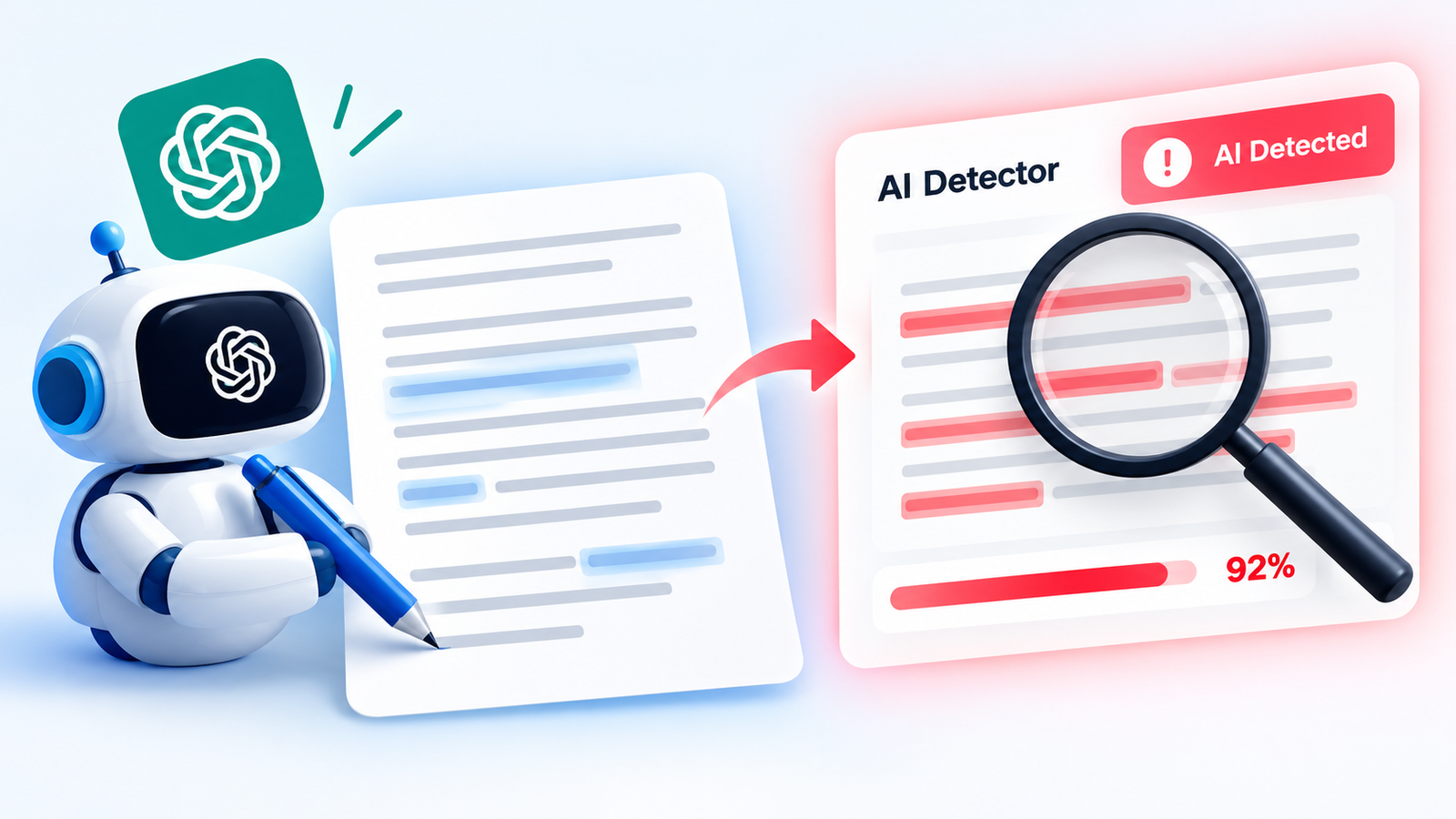
AI is detected in writing by measuring how predictable and how uniform the text is. Detection tools run your writing through a language model and check whether each word is the one a machine would most likely have chosen, and whether the sentences all share a similar length and rhythm. Text that scores as very predictable and very even gets flagged as likely AI.
That is a statistical estimate, not proof. Understanding what the tools look for explains both why they catch a lot of raw AI output and why they sometimes accuse people who wrote every word themselves.
The Main Signals AI Detectors Check in a Piece of Writing
Perplexity: how predictable each word is
A language model writes by picking likely next words. We cover that process in how AI chatbots actually generate text. A detector flips this around. It asks how surprised a model would be by your word choices. Low surprise, known as low perplexity, suggests a machine wrote it. Human writing tends to include odd word choices, tangents and the occasional clumsy phrase, all of which raise perplexity.
Burstiness: how much your sentences vary
People write in bursts. A long, winding sentence is followed by a short one. Then a fragment. AI output is usually smoother, with sentences of similar length and structure throughout. Detectors measure that variation, and very even text counts against you.
Trained classifiers: pattern matching at scale
Most commercial detectors also use a classifier, which is a model trained on large sets of human-written and AI-written samples. It learns subtle differences in vocabulary, punctuation and phrasing, then gives a probability score for new text. This is how tools such as Winston AI work, which we cover in our Winston AI review.
Watermarks: hidden signals added by the AI itself
Some AI providers can embed a statistical watermark by slightly biasing which words the model picks, in a pattern that is invisible to readers but detectable with the right key. Google DeepMind described its approach, SynthID, in a paper published in Nature. A watermark only helps if the text came from a model that uses one and has not been heavily edited since.
Evidence outside the text
Teachers and editors often rely on context more than any score: version history in Google Docs or Word showing a whole essay pasted in at once, a sudden change in someone’s writing style, invented references, or leftover chatbot phrases.
How Is AI Detected in Writing by Teachers, Editors and Employers?
In practice it is usually a mix of software and judgment.
- Schools and universities often use detection built into plagiarism platforms, then compare a flagged essay with the student’s earlier work.
- Editors and publishers run submissions through a detector and look for factual errors and fake citations, which are stronger evidence than a percentage.
- Employers may screen cover letters or written tests, although policies vary widely.
A responsible reviewer treats the score as a reason to look closer, not as a verdict.
How Accurate AI Writing Detectors Really Are
Less accurate than their marketing suggests, particularly on short or edited text.
- OpenAI released its own AI text classifier in 2023 and withdrew it within months. By the company’s own figures it correctly identified only 26% of AI-written text and wrongly labelled 9% of human writing as AI. The announcement page now states it is no longer available because of its low accuracy.
- A Stanford-led study, GPT detectors are biased against non-native English writers, found that detectors consistently misclassified essays by non-native English speakers as AI-generated while judging native speakers’ essays correctly.
Detectors have improved since then, but the basic limitation remains. They estimate probability from style, and style overlaps between people and machines.
Why Human Writing Sometimes Gets Flagged as AI
- Formal or formulaic writing. Lab reports, legal text and five-paragraph essays follow predictable patterns.
- Writing in a second language. A smaller vocabulary and simpler sentence structures look statistically “safe”, which is exactly what detectors associate with AI.
- Heavy use of grammar tools. Rewriting suggestions smooth out the irregularities that mark text as human.
- Short samples. A single paragraph does not contain enough signal for a reliable score.
- Well-known text. Famous passages can be flagged because models have seen them so often that they predict them perfectly.
What to Do If Your Own Writing Is Wrongly Flagged as AI
- Stay calm and ask to see the report. Find out which tool was used and what score it gave.
- Show your process. Version history, drafts, notes, outlines and research tabs are the strongest evidence you can offer.
- Offer to talk it through. Being able to explain your argument and sources in person is convincing in a way no score is.
- Point to the known limits. The OpenAI figures and the study above are fair to cite when a decision rests on a detector alone.
Going forward, write in a tool that keeps version history. It costs nothing and settles most disputes before they start.
Frequently Asked Questions About AI Detection in Writing
Can AI detectors be 100% sure that text was written by AI?
No. Every detector produces a probability, and false positives and false negatives both happen.
Does editing AI text make it undetectable?
Substantial rewriting lowers detection scores because it changes the word choices and rhythm the tools measure. Light edits usually do not change much.
Do detectors work on every AI model?
They work best on the models they were trained against. Text from newer or less common models is detected less reliably until the tools are updated.
Is using an AI detector on someone’s work proof of cheating?
Not on its own. A flag is a signal to investigate further, which is why most academic integrity policies ask for additional evidence.
1 thought on “How Is AI Detected in Writing? What Detectors Really Look For”
Comments are closed.