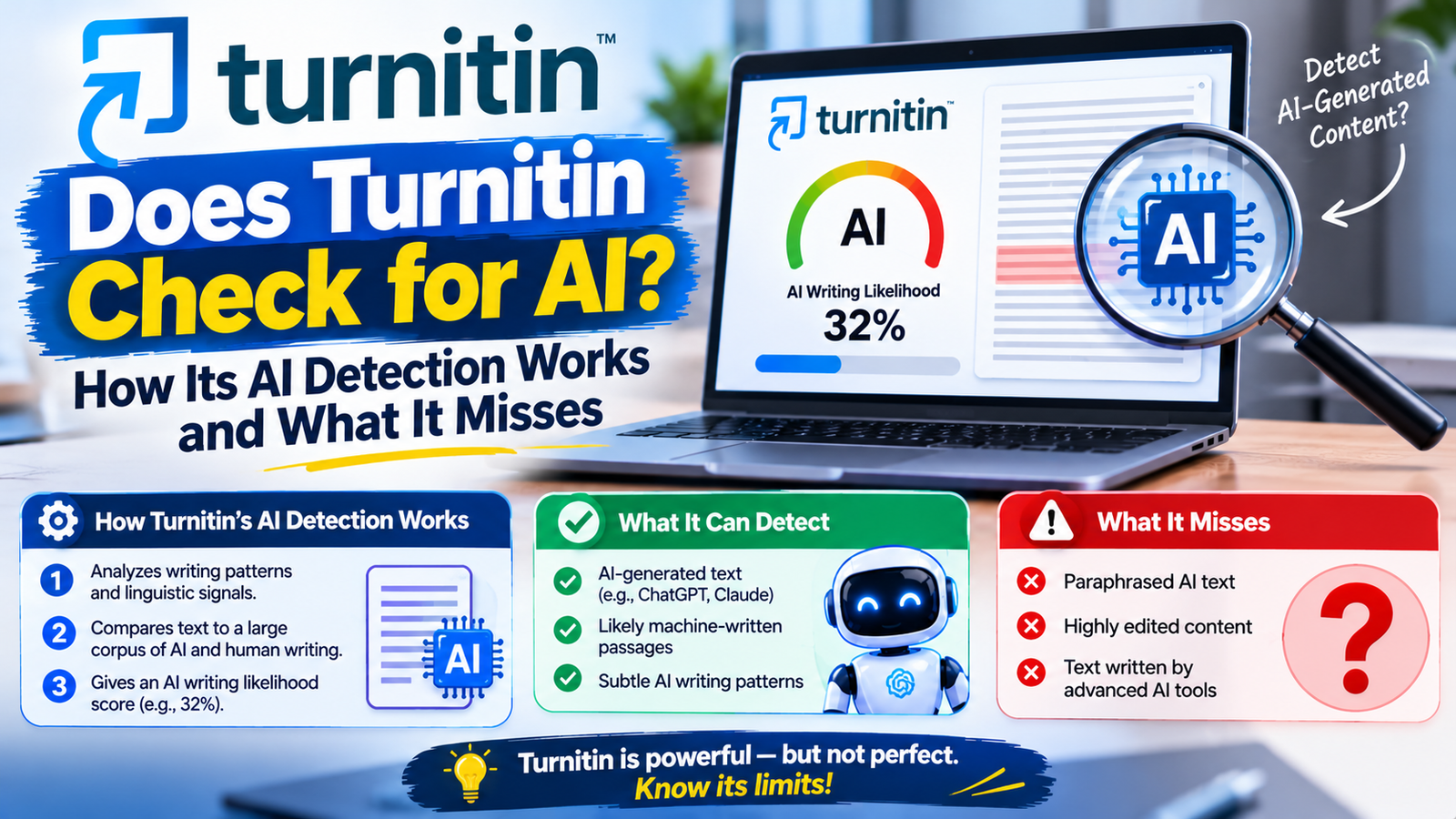
Yes, Turnitin checks for AI. Alongside its plagiarism check, Turnitin runs an AI writing detector that estimates how much of a submission was likely written by a tool such as ChatGPT, Gemini or Claude, and shows that figure to the instructor as a percentage. It has been part of Turnitin since April 2023.
What matters more is how that number is produced, what it can and cannot see, and how much weight it deserves. Here are the facts, taken from Turnitin’s own documentation.
Turnitin AI Detection at a Glance
| Question | Short answer |
|---|---|
| Does Turnitin detect AI writing? | Yes, in long-form prose |
| Minimum length it will check | 300 words of prose |
| Maximum length | 30,000 words |
| Languages | English, Spanish, Japanese and Arabic |
| File types | .docx, .pdf, .txt and .rtf |
| Does it catch paraphrased AI text? | Yes, in English submissions |
| Who sees the AI score? | The instructor, unless the school chooses to show students |
| Is the score proof of cheating? | No. Turnitin says it should not be the sole basis for action |
How Does Turnitin Check for AI in a Submission?
Turnitin breaks the document into overlapping chunks of a few sentences and scores each one on how closely it matches the patterns of machine-written text. Those scores are combined into a single percentage of “qualifying text” that the system believes is AI-generated, and the flagged passages are highlighted in the report.
The underlying idea is the one behind most detectors: AI models choose predictable words and produce very even sentences. We cover those signals in detail in how AI is detected in writing.
Two details are worth knowing:
- The AI check is separate from the similarity score. The similarity report compares your text against existing sources. The AI report looks at writing style. A paper can score 0% similarity and still be flagged for AI, or the other way round.
- Low scores are hidden. Anything from 1% to 19% is shown as an asterisk with no number, because Turnitin says false positives are more common in that range.
What Turnitin’s AI Detector Can and Cannot Catch
What it is built to detect
- Text generated by large language models and pasted in with little or no editing.
- AI text that was then run through a paraphrasing tool, word spinner or “AI bypasser”. Turnitin added this in its English detector.
What it does not handle well
- Short work. Anything under 300 words of prose is not scored.
- Non-prose content. Turnitin says the model is not reliable on poetry, scripts, code, bullet points, tables or annotated bibliographies.
- Other languages. Only the four listed above are supported, and paraphrase detection is English only.
- Heavily rewritten text. Once someone has substantially rewritten AI output in their own words, there is less of the original pattern left to find.
How Accurate Is Turnitin at Detecting AI Writing?
Turnitin has said its document-level false positive rate is below 1% for papers where at least 20% of the text is flagged. That is the company’s own figure, and it applies to a specific situation. Individual sentences are misjudged more often, which is why low scores are hidden.
Independent research on AI detectors in general has been less flattering. A Stanford-led study found that detectors frequently mislabelled essays by non-native English writers as AI-generated, and some universities have chosen to switch Turnitin’s AI indicator off. The fairest summary is that the tool is good at spotting unedited AI text in long English essays and less dependable everywhere else.
If you want to see how a dedicated detector performs, we looked at one in our Winston AI review.
Can Students See Their Turnitin AI Score?
Usually not. The AI writing report is shown to instructors and administrators. Students see it only if their institution has turned that option on. If you want to know your score, ask your instructor, since they can share or download the report.
What to Do If Turnitin Flags Your Own Writing as AI
- Ask for the report. You are entitled to know the percentage and which passages were highlighted.
- Show your drafting history. Version history in Google Docs or Word, outlines, notes and research sources are the strongest evidence that the work is yours.
- Offer to discuss the paper. Explaining your argument and sources in person is persuasive.
- Refer to Turnitin’s own guidance. Its documentation says the score “should not be used as the sole basis for adverse actions against a student”. You can find that wording in the guide to using the AI Writing Report.
For future assignments, write in a tool that saves version history. It is the simplest protection there is.
Frequently Asked Questions About Turnitin and AI
Does Turnitin detect ChatGPT?
Yes. Its detector is trained to recognize text from ChatGPT and other large language models.
Does Turnitin flag Grammarly?
Basic spelling and grammar fixes are unlikely to cause a flag. Features that rewrite whole sentences or paragraphs with AI can, because the result is AI-generated text.
Does Turnitin check for AI in every submission?
Only where the institution has the AI writing feature enabled, and only for files that meet the length, language and format requirements.
Can Turnitin detect AI in a paper written in another language?
It supports English, Spanish, Japanese and Arabic. Submissions in other languages are not scored for AI.