
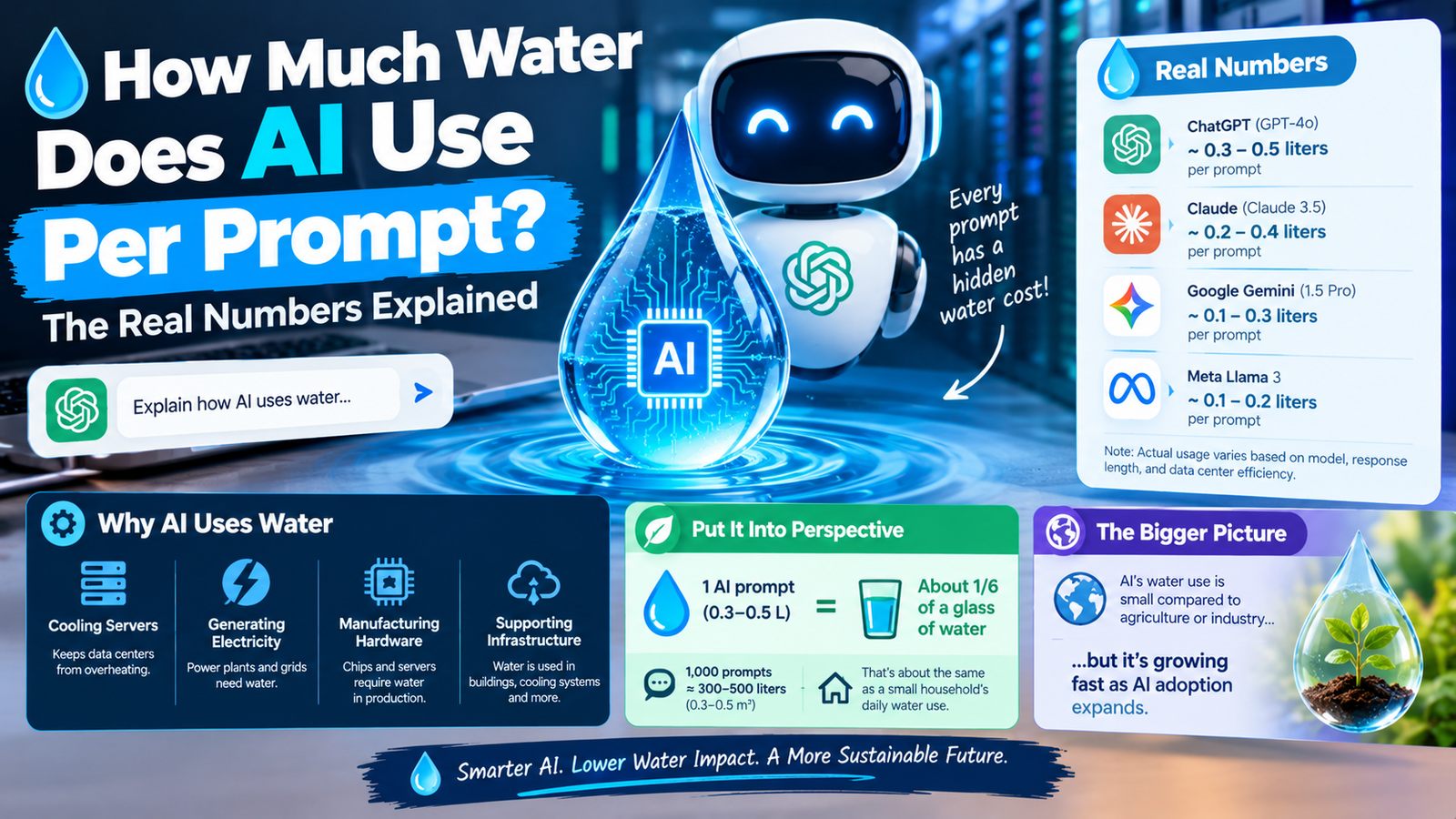
A typical AI text prompt uses a fraction of a millilitre of water. Google reports that a median Gemini text prompt consumes about 0.26 ml, roughly five drops, and OpenAI’s Sam Altman has put an average ChatGPT query at around 0.32 ml. Older estimates of “a bottle of water per prompt” counted more things and were based on older hardware.
Both sets of numbers are real. They measure different things, and knowing which is which is the only way to make sense of the headlines.
How Much Water Does AI Use Per Prompt According to Each Source?
| Source | Water per prompt | What it counts |
|---|---|---|
| Google, Gemini text prompt (August 2025) | 0.26 ml | Water used for cooling at the data center |
| OpenAI, average ChatGPT query (2025) | About 0.32 ml | Company statement, method not published |
| Washington Post and UC Riverside (2024) | About 519 ml for a 100-word email | Cooling water plus water used to generate the electricity |
| Academic benchmark of many models (2025) | Under 2 ml for efficient models, over 150 ml for some reasoning models | Modelled estimates that include infrastructure |
Google’s figures come from a technical report it published in August 2025, which also put the energy for a median prompt at 0.24 watt-hours. Data Center Dynamics covered the report along with the criticism it received.
Why the Estimates Range From Five Drops to a Full Bottle
Three choices explain almost all of the gap.
1. Which water is being counted
- On-site water is what a data center evaporates to keep its servers cool. This is what Google’s 0.26 ml covers.
- Off-site water is what power plants use to generate the electricity the data center runs on. It is often larger than the on-site figure, and the higher estimates include it.
- Manufacturing water goes into making the chips. It is rarely included in per-prompt numbers at all.
2. How big the task is
A one-line question and a long report are very different amounts of computing. So are a simple model and a “reasoning” model that works through a problem step by step before answering. Image and video generation use more again. If you are curious why longer answers cost more, see what tokens are in AI.
3. Where and when the estimate was made
The widely quoted bottle-per-email figure grew out of research by a team at UC Riverside, published as Making AI Less Thirsty, and it reflected the hardware and models of the time. Chips and software have become far more efficient per prompt since then. Location matters too. A data center in a hot, dry region that relies on evaporative cooling uses far more water than one in a cool climate with closed-loop or air cooling.
What the Company Numbers Leave Out
The small figures from Google and OpenAI are useful, but they come with caveats.
- They are self-reported. Neither figure has been independently audited, and OpenAI has not published its method.
- They exclude training. Building a large model takes weeks or months of intensive computing before anyone sends a single prompt.
- They exclude electricity-related water. Critics of Google’s report pointed out that leaving this out makes the total look smaller.
- They describe a typical text prompt. Heavy requests sit well above the median.
So the honest range for a text prompt today is somewhere between a few drops and a few millilitres for cooling, and more once power generation is added.
Why Tiny Amounts Per Prompt Still Add Up to a Real Problem
Five drops sounds like nothing, and for one person it is. A thousand prompts at Google’s figure comes to 260 ml, about one glass of water.
The issue is scale and location. AI services handle billions of requests a day, and the computing is concentrated in specific places. A single large data center can draw millions of gallons of water a day, sometimes from the same supply that local homes and farms depend on. That is why the debate is less about your individual chats and more about where data centers are built, how they are cooled and whether the water is returned or replaced.
For background on what all that computing is actually doing, our explainer on how AI works walks through training and inference.
How to Lower the Water and Energy Footprint of Your Own AI Use
- Use the lighter model for simple tasks. Save reasoning or “thinking” modes for problems that need them.
- Ask once, clearly. A well-written prompt beats five rounds of regenerating.
- Go easy on images and video. They are the most resource-hungry requests.
- Keep it in proportion. Your everyday choices about food, travel and heating have a far larger water and energy footprint than chatting with an AI.
Frequently Asked Questions About AI and Water Use
Does AI actually “use up” water?
Mostly through evaporation. Cooling systems turn water into vapour to carry heat away, so that water leaves the local supply even though it returns to the wider water cycle.
Does generating an image use more water than a text prompt?
Yes. Image and video generation need more computing than a short text answer, so they use more energy and more cooling water.
Is ChatGPT worse for water use than a Google search?
An AI answer generally takes more computing than a traditional search result, although the gap has narrowed as models have become more efficient and as search engines have added AI answers of their own.
Are AI companies doing anything about it?
Several have pledged to replenish more water than they consume by 2030 and are moving new sites towards cooling designs that use little or no water. Whether those pledges are met is something to watch.