
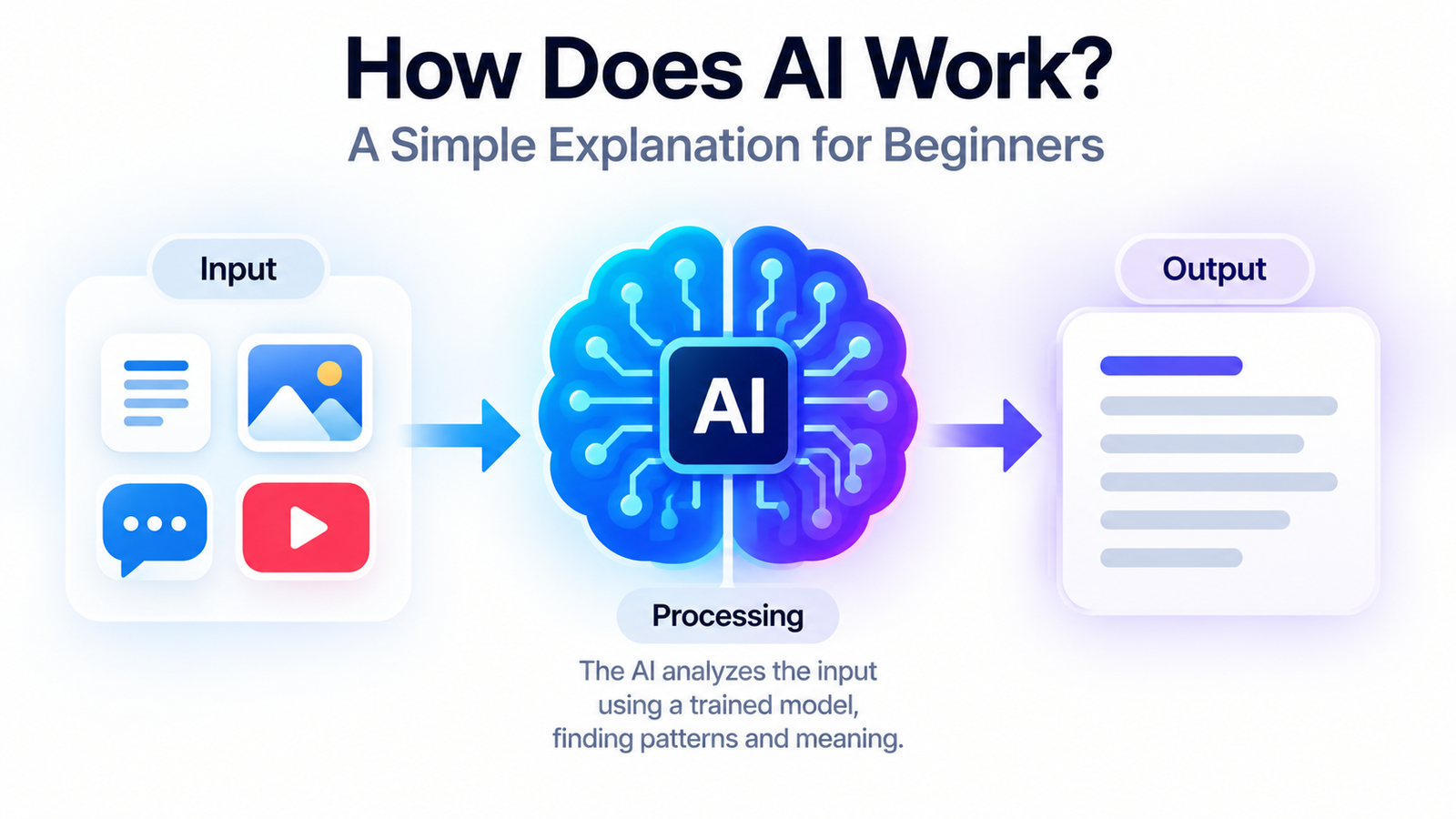
AI works by learning patterns from very large amounts of data and then using those patterns to make a prediction, whether that prediction is the next word in a sentence, the object in a photo, or the film you are likely to watch next. Nobody writes the rules by hand. The system works them out for itself during a process called training.
That is the whole idea in two sentences. The rest of this guide walks through how it happens, using everyday examples and no maths.
How Does AI Work? The Three Things Every AI System Needs
Strip away the hype and every modern AI system is built from the same three ingredients.
- Data. Examples to learn from: text, images, audio, clicks, sensor readings. More varied examples usually mean a more capable system.
- A model. A large mathematical structure, usually a neural network, with millions or billions of adjustable settings called parameters.
- Computing power. Specialized chips that can run the enormous number of calculations needed to adjust all those settings.
If you are still fuzzy on what counts as AI in the first place, start with our short primer on what artificial intelligence is and then come back here.
How an AI Model Learns From Data During Training
Imagine teaching a child to recognize dogs. You would not hand over a rulebook about ear shapes and tail lengths. You would point at dogs, again and again, until the child just gets it. Training an AI model follows the same logic, only at a much larger scale.
Step 1: The model makes a guess
The model is shown an example, say a photo, and produces an answer. At the start its settings are random, so the answer is basically a coin toss.
Step 2: The guess is compared with the right answer
The training data includes the correct label. The system measures how far off the guess was. That gap is called the error, or loss.
Step 3: The settings are nudged to reduce the error
An algorithm works backwards through the model and adjusts each parameter by a tiny amount so that the same example would produce a slightly better answer next time.
Step 4: Repeat this millions of times
One nudge changes almost nothing. Millions or billions of nudges, across a huge range of examples, gradually turn random settings into ones that capture real patterns. When training ends, those settings are saved. That saved file is the model.
Google’s free Machine Learning Crash Course covers these steps in more depth if you want to go further.
What Happens When You Actually Use an AI Tool
Using a trained model is called inference, and it is much cheaper and faster than training. Your input, such as a question or a photo, is converted into numbers, passed through the model’s saved settings, and turned into an output.
The important point is that the model is not looking anything up in a database of answers. It is calculating the most likely output based on the patterns it absorbed. That is why the same AI can handle a question it has never seen before, and also why it can be wrong.
How Generative AI Like ChatGPT Is Different From Older AI
Older AI systems mostly sorted things into categories: spam or not spam, cat or dog, approve or decline. Generative AI produces new content instead.
A chatbot does this by predicting text one small piece at a time. It looks at everything written so far, estimates which piece is most likely to come next, adds it, and repeats. Those pieces are called tokens, and we cover them in what tokens are in AI and why they cost money. For the full walkthrough of a chatbot reply, read how AI chatbots actually generate text.
The design that made this practical is called the transformer, introduced by Google researchers in the 2017 paper Attention Is All You Need. Its key trick is attention, which lets the model weigh how much each earlier word matters when choosing the next one.
Why AI Gets Things Wrong Even When It Sounds Confident
Because AI predicts what is likely and does not check what is true, a few weaknesses come built in.
- Made-up facts. A language model can produce a fluent, confident sentence that is simply false. This is often called hallucination.
- Bias. If the training data over-represents some groups or viewpoints, the model’s output will lean the same way.
- Stale knowledge. A model only knows what was in its training data unless it is connected to live search or other tools.
- No common sense by default. It can miss things any person would catch, because it has patterns, not lived experience.
This is why checking important answers against a trusted source is still your job, not the AI’s.
Does AI Actually Understand or Think Like a Person?
Not in the way people do. A model has no goals, feelings or awareness. It has a very detailed statistical picture of how words, pixels or sounds tend to go together. That picture is good enough to write an essay or spot a tumor on a scan, which is remarkable, but it is still pattern matching at scale. Researchers do not all agree on how far that takes us, and it is an open debate.
Common Questions About How AI Works
Is AI the same as machine learning?
Machine learning is the main method used to build AI today. AI is the broader goal of getting computers to do tasks that normally need human intelligence. IBM has a clear overview of how machine learning fits into AI.
Does AI keep learning from my conversations?
Not while you are chatting. A model’s settings are fixed once training ends. Companies may use conversations to train future versions, depending on their policy and your privacy settings, so check those if it matters to you.
Do you need to know how to code to use AI?
No. Most AI tools work through plain language. Coding only becomes necessary if you want to build or train models yourself.
How long does it take to train an AI model?
Anything from a few minutes for a small model on a laptop to several months for the largest language models running on thousands of specialized chips.